


Bus Jam: Traffic Trouble
Gimica GmbH
Bus Jam: Traffic Trouble is the kind of casual game I can open for a few minutes without needing to remember a complicated story, a long control scheme, or a difficult set of rules. Its central idea is easy to understand: passengers need to be sorted into the right buses, and the traffic jam has to be cleared through careful choices. That simplicity is its biggest attraction, but it also means the game depends heavily on whether you enjoy short visual puzzles rather than deep progression or action.
I found the first few moments reassuring because the goal is visible almost immediately. You look at the waiting passengers, identify the bus that matches them, and decide which move will create space instead of making the crowd harder to manage. The game is free, rated for Everyone, and belongs firmly in the casual category. It is a natural fit for a quick break, a waiting room, or a short evening session when I want something interactive but not demanding.
Developed by Gimica GmbH, the game has reached over one hundred thousand installs and holds a 4.6 average from around five thousand ratings. Those figures suggest that its straightforward puzzle loop has found an audience, although they do not change the basic question you should ask yourself: do you like organizing a crowded board one decision at a time? If the answer is yes, this is an approachable place to start.
What the first session feels like
The opening experience is built around recognition rather than memorization. I do not need to learn a character roster or understand a complicated economy before making progress. The visual arrangement presents the problem: passengers are waiting, buses have particular destinations or colors, and the order of movement matters. My job is to read the layout, choose a useful bus, and avoid wasting the limited room available around the jam.
That makes the game especially suitable for first-time puzzle players. The basic action is not hidden behind a large menu system, and the store summary, “Sort Riders, Clear the Jam,” accurately captures the mental rhythm. I am not racing against another player. I am trying to turn a messy arrangement into a clean one, which gives each successful move a small sense of relief.
Related News






The best way to approach the first stage is not to tap as quickly as possible. I recommend pausing for a moment and scanning the whole board. Look for passengers who can be removed immediately, then check whether that move opens access to a more useful group behind them. A bus that seems convenient may be a poor choice if it leaves the remaining passengers blocked. This early habit is more valuable than speed because the puzzle is about order, not simply matching.
For me, the appeal comes from the contrast between a simple rule and increasingly careful decisions. At first, sorting feels almost automatic. Then a crowded arrangement makes the same rule less forgiving. I have to think about what will happen after the current bus leaves, not only what can be completed right now. That small shift is where the casual format becomes a genuine puzzle.
Getting started without overthinking the setup
The game runs on Android devices using version 7.0 or later. Once installed, I would begin with the sound and visual presentation at a comfortable level, then move directly into the first playable board rather than spending time searching for advanced options. The current version is 1.0.4, so the practical priority is simply to make sure the app opens properly on your device and that the controls feel responsive.
Gallery
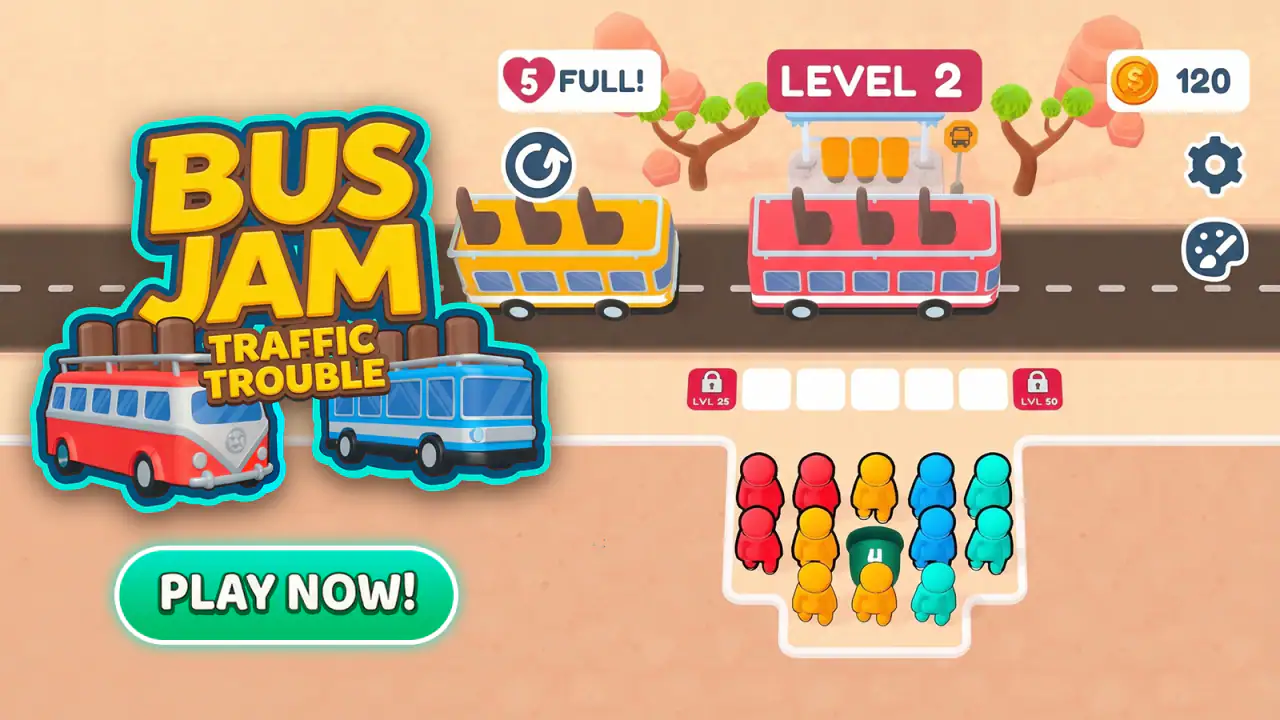
There is no reason to treat the first board as a test of skill. Use it to learn the visual language. Notice how the game distinguishes passengers and buses, how a selected object responds, and what happens after a successful movement. This is also the point where you can decide whether the interface is comfortable for your screen size. A puzzle based on crowded visual elements needs to be readable, especially if you are playing on a smaller phone.
My suggested setup for a new player is simple:
- Play the opening board with the goal of understanding the matching rule, not finishing quickly.
- Before each move, identify which passengers will become available afterward.
- Keep an eye on open space and avoid filling it with a choice that does not help the next turn.
- If a move looks unclear, wait and inspect the arrangement instead of tapping repeatedly.
This approach makes the first meaningful success feel earned without making it stressful. You are learning how the board communicates its priorities. In a casual puzzle, that communication matters more than a flashy introduction because it determines whether later levels feel satisfying or confusing.
The first successful action and why it matters
Your first useful move should be the one that improves the board, not necessarily the one that completes the largest group. I usually look for a passenger or small set that can be matched cleanly while opening a route for the next bus. That creates a chain of progress: one correct decision removes an obstruction, the newly visible space reveals another option, and the board begins to breathe again.
This is an important distinction for new players. A move can be correct in isolation and still be unhelpful overall. For example, taking the easiest available group may leave a more urgent group trapped behind it. The game rewards awareness of sequence, so I try to ask myself, “What will I be able to do after this?” before committing.
A practical technique is to divide the board mentally into three parts: the passengers that can move now, the passengers that may become available soon, and the passengers that are currently irrelevant because the surrounding space is blocked. I start with the first group, but I choose from it based on how well it exposes the second. This keeps the decision-making manageable without requiring a written plan.
When the first board clears, the satisfaction is modest but real. The game does not need a dramatic victory scene to make the result understandable; the cleaned-up traffic arrangement is the reward. That is why I think it works well for short sessions. A single completed challenge can feel complete, while a longer session gives you room to refine your judgment.
Where new players commonly get confused
The most common mistake is treating every visible match as equally valuable. A matching bus may be available, but sending it away at the wrong time can leave the board with fewer useful choices. I learned to distinguish between a move that merely removes passengers and a move that improves the entire arrangement. The second type is usually safer.
Another source of confusion is the difference between immediate progress and future access. If a group is easy to reach, it is tempting to select it first. Yet the better move may be the one that clears a narrow obstruction or preserves open space for a bus that will matter later. This is not a complicated strategy system; it is simply the logic of managing a crowded board.
Players can also become impatient when the next move is not obvious. In those moments, random tapping is rarely helpful. I recommend stopping and checking which passengers are actually reachable, then looking for a move that changes the shape of the board. If nothing seems promising, reconsider the last choice rather than assuming the puzzle is unfair. Often the problem began one move earlier.
The game’s casual presentation may encourage relaxed play, but relaxed does not mean mindless. I enjoy it most when I give myself permission to slow down. A short pause costs less than a chain of rushed choices, and it helps reveal whether I am solving the current obstruction or merely postponing it.
Useful habits for clearing tougher arrangements
One of the most useful habits is preserving flexibility. When several buses appear possible, I avoid using the option that leaves the fewest ways forward unless it also removes a major blockage. Open space is valuable because it gives later passengers somewhere to move and keeps the board from becoming visually compressed.
A second habit is planning one step beyond the current match. I do not try to predict the entire solution, because that can make a casual puzzle feel unnecessarily heavy. Instead, I ask whether the next likely action will still be available after the move I am considering. This limited planning is enough to prevent many avoidable dead ends.
A third insight is that the most visible group is not always the priority. Crowded boards naturally draw the eye toward the largest cluster, but a smaller group near an important route may have greater strategic value. Clearing that smaller group can expose several better choices, while clearing the large cluster may simply create a different blockage.
I also recommend changing your pace according to the board. On an open arrangement, quick decisions are fine. On a tightly packed one, I inspect every available option before acting. This makes the game feel less like repetitive tapping and more like a series of small traffic-control problems, which is where its strongest personality appears.
How it fits into an everyday routine
I can see myself using Bus Jam: Traffic Trouble during a short commute pause, while waiting for food, or between larger tasks. A board gives me a contained objective, so I do not need to reserve a full evening for it. The game is also a reasonable choice for someone who wants a gentle activity that still asks for attention. It is more engaging than passively scrolling, but less demanding than a competitive action game.
For a parent looking for an Everyone-rated game, the simple sorting premise is approachable. Even so, I would still judge the experience by the individual player’s tolerance for repetition and visual concentration. The age rating describes suitability, not whether every player will find the loop interesting. Younger players may enjoy the matching idea, while adults may appreciate the quiet, orderly rhythm after a busy day.
It is less suitable when you want a strong narrative, character development, or a complex long-term strategy. It also may not satisfy players who need constant action or direct competition. Compared with a traditional arcade game, its tension comes from making the right choice rather than reacting quickly. Compared with a deeper logic puzzler, it is easier to enter but may offer less intellectual variety for someone seeking elaborate systems.
That comparison is important before installing. The game’s strength is accessibility: I can understand the purpose quickly and begin making useful decisions almost at once. Its trade-off is that the same focused loop may feel repetitive if sorting and clearing traffic do not hold your attention. I would recommend it to a friend who enjoys tidy-up puzzles, while pointing a strategy enthusiast toward a more complex alternative.
What to expect from longer play
As I continue, the main challenge is not learning a new genre but becoming more disciplined within the same idea. Early confidence can lead to careless moves because the rules feel obvious. Later arrangements punish that habit by making the order of actions more important. The game works best when I treat each board as a small planning exercise rather than assuming the next match will always be safe.
The free price makes experimentation easy. You can install it without committing money and quickly decide whether the central loop suits you. That is particularly useful here because enjoyment depends on personal preference more than on a long feature checklist. If the first successful clear gives you a satisfying feeling of order, you are likely to understand the appeal. If it feels like busywork, additional time may not change your opinion.
I would also keep expectations realistic about the role of the game in a larger mobile library. This is a focused casual title, not a replacement for a full strategy game or a story-driven adventure. Its value is in small, repeatable moments of concentration. I like that narrow purpose, provided I am in the mood for a puzzle that asks me to organize rather than explore.
The developer, Gimica GmbH, has given the game a clear identity through that single activity. The best sessions are the ones where I enter with a small amount of time, solve a board thoughtfully, and stop before the loop becomes tiring. That makes it easy to recommend as a pocket-sized diversion rather than something that needs to dominate your gaming schedule.
My recommendation after trying the complete loop
Bus Jam: Traffic Trouble is strongest when you want a calm, readable puzzle with an immediate goal. The path from installation to first success is gentle: open the game, learn the matching relationship, scan the board, and make a move that creates better access for what follows. That process gives a new player enough guidance to feel capable without removing the need to think.
I appreciate the way a simple traffic problem becomes a lesson in sequencing. The most useful decisions are often not the biggest ones, and the best move may be the one that preserves options rather than producing instant progress. Those details give the game more substance than its short description suggests, while still keeping the experience friendly to casual players.
There are limits. The focused format can become repetitive, and players looking for story, competitive pressure, or substantial strategic depth should choose something else. The game also asks for visual patience: if you rush through a crowded arrangement, you can create problems that a slower scan would have avoided. Those are not flaws for the intended audience, but they are real reasons some people will not connect with it.
For me, the final verdict is positive but specific. I would install it for short puzzle breaks, recommend it to someone who likes sorting and organizing challenges, and suggest beginning with a deliberate scan instead of fast tapping. With a 4.6 average, over one hundred thousand installs, free access, and an Everyone rating, it is an easy game to try. Just approach it for what it is: a compact exercise in clearing a jam one well-chosen move at a time.
FAQs for Bus Jam: Traffic Trouble
What is Bus Jam: Traffic Trouble, and how is it played?
Bus Jam: Traffic Trouble is a casual puzzle game focused on organizing busy roads and matching passengers with the correct buses. You generally need to plan the order of vehicles, clear traffic, and avoid blocking important spaces. The early stages are easy to understand, but later levels require more careful timing, color matching, and strategic thinking to prevent the board from becoming overcrowded.
Is Bus Jam: Traffic Trouble free to download and play?
The game can usually be downloaded and played for free, although it may include optional in-app purchases. These purchases can provide extra moves, boosters, coins, or other helpful items when a level becomes difficult. You do not necessarily need to spend money to progress, but free players may encounter advertisements and may need to replay levels or wait for additional resources.
Does Bus Jam: Traffic Trouble require an internet connection?
An internet connection may not be necessary for every part of Bus Jam: Traffic Trouble, so some levels can often be played offline. However, online access may be required for advertisements, cloud saving, special events, updates, purchases, or synchronized progress between devices. Availability can vary by version and platform, so it is best to test offline play after installation.
Is Bus Jam: Traffic Trouble suitable for children?
Bus Jam: Traffic Trouble uses simple controls, colorful visuals, and straightforward puzzle mechanics, making it accessible to many younger players. Nevertheless, parents should review the age rating, advertising content, and in-app purchase settings before allowing children to play. Later puzzles can become challenging, and some players may feel encouraged to use boosters or watch advertisements to continue.
What devices are compatible with Bus Jam: Traffic Trouble, and does it take much storage?
Compatibility depends on the Android or iOS version available in your region, as well as the requirements listed on the official app store page. The game is designed for modern smartphones and tablets, but older devices may experience slower loading, reduced performance, or limited support. Check the required operating-system version and available storage before downloading, especially if your device has little free space.
Pros
- Simple tap controls make the game easy to learn within minutes.
- Short levels suit quick gaming sessions during commutes or breaks.
- Colorful visuals and playful animations make the traffic puzzles engaging.
- Increasing difficulty keeps later stages more challenging than the opening levels.
- Offline play lets you enjoy many puzzles without a constant internet connection.
Cons
- Repeated sorting mechanics may feel monotonous after extended play sessions.
- Some levels rely more on trial and error than careful strategic planning.
- Ads can interrupt gameplay
- especially between completed levels.
- Later puzzles may feel frustrating when a single mistake forces a restart.
- Progression can become slow if optional purchases are used to speed things up.


